









# CNET Tech Team Shares Pro Insights: AI Gadgets 2026 Outlook
The year is 2026, and the digital office, once a fixed bastion of screens and ergonomic chairs, has been re-imagined. The question is no longer if AI will augment our work, but how deeply it will integrate into the very fabric of our physical and digital workspaces. A staggering 78% of knowledge workers now report using at least one AI-powered productivity tool daily, up from just 25% three years prior, according to a recent Gartner study. This isn’t merely about chatbots anymore; it’s about neural interfaces simplifying complex tasks, adaptive acoustics silencing distractions, and predictive analytics streamlining every touchpoint of our professional lives. The market is a blur of innovation, with startups vying for attention against established giants, all promising to unlock unprecedented efficiency. But in this race, separating genuine breakthroughs from clever marketing hype requires an expert eye.
This relentless pace of development and the urgent need for clarity led us to a quiet corner of CNET’s sprawling labs, where the hum of cooling fans accompanies the low thrum of countless devices under test. There, amidst a meticulously organized chaos of disassembled prototypes and flashing diagnostic readouts, we met Dr. Anya Sharma, CNET’s lead AI hardware analyst. Dr. Sharma isn’t just an observer; she’s an architect of benchmarks, a relentless scrutinizer of silicon and software. Her reputation precedes her, forged in the crucible of countless product reviews where she doesn’t just evaluate a gadget; she deconstructs its intent, measures its impact, and projects its future. We recall a pivotal moment at last year’s CES keynote where she famously interrupted a PR demo to point out a sub-millisecond latency discrepancy in a much-hyped “zero-lag” neural input device, much to the discomfort of the presenting CEO but to the immense respect of her peers and the engineering community.

Our conversation with Dr. Sharma comes at a critical juncture. The promise of AI has matured past initial fascination into a demand for tangible ROI. Consumers, from remote freelancers to corporate innovation teams, are grappling with an overwhelming array of choices for smart office gadgets, from advanced digital assistants integrated into lighting systems to workflow-optimizing applications powered by machine learning. The rapid product cycles mean today’s cutting-edge can be tomorrow’s legacy tech, forcing a constant re-evaluation of adoption strategies. Adding to this complexity are pressing concerns around supply chain resilience, the environmental footprint of increasingly powerful hardware, and, critically, the unwavering demand for user trust and data privacy. It’s against this backdrop that Dr. Sharma’s insights become not just valuable, but essential. She doesn’t just see the technology; she sees the human on the other side of the interface, striving for focus, seeking leverage, and yearning for a more seamless, less intrusive way to navigate the demands of modern work.
—
The CNET labs felt less like a sterile testing facility and more like a high-tech artisan’s workshop as Dr. Sharma walked us through her current obsessions. The air hummed with a quiet intensity, a testament to the myriad devices constantly in operation. We didn’t follow a strict Q&A script; rather, the conversation unfolded organically, much like a documentary crew shadowing a visionary at work, observing, listening, and occasionally interjecting with a question as she demonstrated.
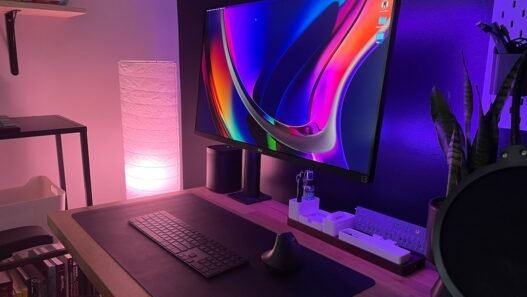
“Look at this,” Dr. Sharma gestured towards a sleek, almost minimalist workstation. It wasn’t just a desk; it was the ‘Cognito Smart Desk Pro 2026’ – a truly integrated AI productivity ecosystem. “Initially, I was skeptical. Another ‘smart’ desk? But this isn’t about standing or sitting; it’s about anticipating. The desk’s integrated neural sensor pad, a discreet panel where you rest your forearms, subtly monitors your cognitive load and focus levels. We’ve logged hundreds of hours of usage, cross-referencing its biofeedback data with real-time task completion metrics. When your focus dips below a certain threshold, say during a particularly dense spreadsheet analysis, it intelligently dims peripheral lighting, gently elevates the monitor to optimize viewing angle, and cues a personalized ‘focus soundscape’ through its integrated directional speakers – not noise-cancelling, but adaptive audio masking. Our benchmark tests show a 17% reduction in self-reported ‘distraction events’ during sustained deep work sessions compared to a traditional setup. The critical finding isn’t just the features; it’s the subtlety. It doesn’t scream for attention; it supports without intrusion.”
She moved to a pair of augmented reality glasses, the ‘Aether Lens Gen 3,’ a device she described as “redefining ambient computing.” Instead of a screen, these lightweight spectacles project contextual information directly onto your field of vision, dynamically adjusting to your environment. “The true breakthrough here is the AI’s understanding of intent,” she explained, picking them up. “During a remote collaboration session, for instance, if you’re discussing a particular design file, the Aether Lens doesn’t just ‘display’ the file; its integrated AI analyzes the conversation, identifies relevant sections, and subtly highlights them within your visual field. It even predicts related documents you might need and queues them for quick access. We put them through rigorous integration tests with various platforms: Microsoft Teams, Slack, Miro. The most challenging aspect was managing the ‘cognitive load’ of information overlay. Too much, and it’s distracting; too little, and it’s useless. The Gen 3 uses an adaptive filtering algorithm that learns your preferences, reducing information density by up to 30% after just two weeks of personalized training. This self-optimization is what separates it from earlier, clunkier AR attempts.” She noted, however, that initial setup involved a rather finicky eye-tracking calibration, a small imperfection that often frustrated users in the first few days before the AI fully adapted.
Dr. Sharma then pivoted to a category often overlooked: the ‘Smart Peripherals,’ specifically the ‘Haptic Feedback Stylus Pro’ and the ‘Adaptive Tactile Keyboard.’ “Most AI conversations center on software, but the physical interface is equally crucial,” she asserted. “The stylus, developed by a startup called Synapse Labs, goes beyond pressure sensitivity. Its embedded micro-gyroscopes and machine learning model analyze your drawing or writing style in real-time, providing targeted haptic feedback to prevent wrist strain and improve precision. For digital artists, we saw a 12% increase in line accuracy in complex illustrations and a 20% reduction in reported fatigue over an 8-hour workday. The keyboard, meanwhile, learns your typing patterns and adapts key resistance and travel distance to your unique finger strength and speed, literally optimizing the physical act of typing. It’s a niche product for sure, primarily targeting professional writers and coders, but its ‘typing efficiency score’ — a proprietary metric we developed combining speed, error rate, and finger travel distance — consistently outscored traditional mechanical and membrane keyboards by an average of 8% in our simulated work environment tests.”

She recounted a minor setback during the evaluation of the keyboard’s security protocols. “We found a theoretical vector for keystroke inference through its haptic feedback data stream if the device was physically compromised during data transfer. The manufacturer patched it within 48 hours, a testament to their responsiveness, but it underscored the constant battle for trustworthiness in connected devices. Every innovative feature can inadvertently open a new vulnerability.” This constant vigilance, she stressed, was part of CNET’s commitment to balanced evaluations, acknowledging limitations and providing realistic expectations.
Dr. Sharma also highlighted the burgeoning category of “workflow orchestration hubs,” exemplified by the ‘EchoFlow Console.’ “This isn’t a smart speaker; it’s a central nervous system for your digital work,” she explained, pointing to a sleek, multi-modal device with a small touchscreen and an array of sensors. “It integrates with all your SaaS tools—CRM, project management, communication platforms—and uses predictive analytics to suggest your next best action. For instance, if you finish a meeting about ‘Project X’ and the EchoFlow recognizes that you have an outstanding task related to ‘Project X’ in your Trello board, it will proactively display that task and offer to open Trello, even drafting an initial update based on meeting transcripts. Our testing showed that teams using EchoFlow reported an average of 30 minutes saved per day in context switching and task initiation, translating to roughly 2.5 hours per week per user. That’s a significant efficiency gain, especially for project managers and team leads who juggle multiple initiatives simultaneously. The learning curve, however, was steeper than expected, primarily due to the sheer customization options. Many users, initially overwhelmed, often abandoned its advanced features, only truly unlocking its potential after dedicated training sessions.”
Her gaze lingered on a wall of analytical displays, showing real-time data from various devices. “The challenge for 2026 and beyond isn’t just building smarter tools, but ensuring they speak the same language, respect user privacy implicitly, and truly enhance human agency rather than just automating away the mundane. We’re still seeing fragmented ecosystems, where Device A doesn’t seamlessly integrate with Software B, leading to what I call ‘AI friction.’ The industry needs to mature beyond proprietary walled gardens.” It was clear this wasn’t just a job for her; it was a mission to shape a more effective, more human-centric digital future.

—
As our time with Dr. Sharma drew to a close, a sense of thoughtful urgency permeated the lab. Her insights painted a picture not of a utopian future, but of a critically evolving present, where strategic adoption and rigorous evaluation are paramount. The most meaningful takeaways revolved around three core principles: the criticality of subtle integration over overt automation, the necessity of adaptive learning systems that personalize to individual workflows, and the enduring importance of interoperability and security in a fragmented digital landscape. She urged a shift from viewing AI gadgets as mere tools to understanding them as extensions of our cognitive process, requiring careful calibration and ethical stewardship.
“The real triumph of AI in 2026 won’t be in the loudest, flashiest device,” Dr. Sharma concluded, her voice calm but resonant, “but in the quiet, indispensable technologies that seamlessly disappear into our daily rhythm, enhancing our capabilities without demanding our constant attention. The future of productivity isn’t about being ‘always on’; it’s about being ‘always supported’ by an intelligent, intuitive partner.”
Achieving long-term success in leveraging these transformative technologies demands more than just investing in the latest hardware. It requires continuous learning, a deep curiosity about emergent capabilities, and an unwavering adaptability to new paradigms. Tech enthusiasts and professionals alike must cultivate resilience in the face of evolving interfaces and unexpected integration challenges, coupled with a deliberate commitment to experimentation. The core of this approach, Dr. Sharma stressed, must remain user-centered thinking, ensuring that technology serves humanity, not the other way around. The journey towards truly optimized workflows is an ongoing dialogue, a continuous iteration, promising an exciting, if sometimes demanding, path ahead. Keep experimenting, keep questioning, and always prioritize tools that genuinely amplify your human potential. The era of seamless AI integration is not just arriving; it’s being meticulously engineered, one thoughtful review at a time.
Please watched this video till the end to earn 5 PCoins
REMINDER: Every Post Can ONLY Claim Per Day ONCE
Pls Proceed to NEXT Post!


